OPERATORS of JAVA ;

TYPE OF OPERATORS ;
> Operators means, java are the special type of token in java which when coupled with entities.
> As a variables or constants or data types results in a specific operation.
> Such as examples, addition, multiple, or even shifting of bits.
THE MAINLY FOLLOWING TYPE ;
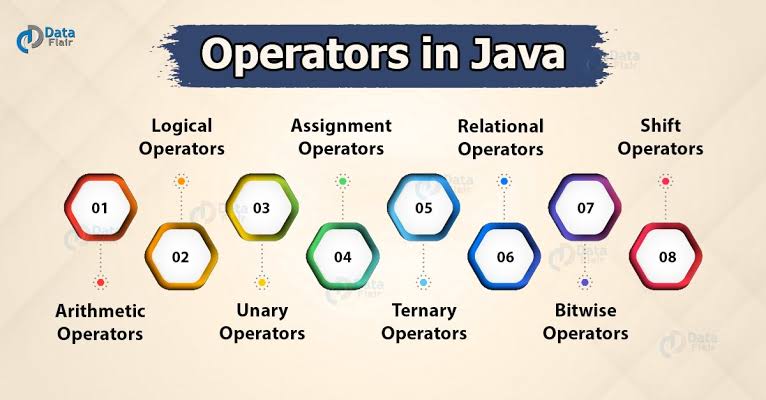
> Arithmetic Operators
> Logical Operators
> Unary Operators
> Assignment Operators
> Ternary Operators
> Relational Operators
> Bitwise Operators
ARITHMETIC OPERATOR ;
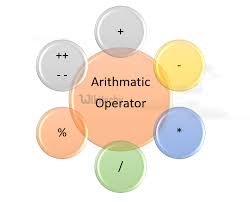
> Arithmetic Operators are used to perform arithmetic operations. There are mainly 5 arthmetic opertor in java.
1. Additional
> A like as, Addition operator performs addition between two entities on either side of the operator.
2.subtraction
> A like as, Subtraction operator performs subtraction between two entities on either side of the operator.
3.multiplication
> A like as, Multiplication operator performs multiplication between two entities on either side of the operator.
4.Division
> A like as ,Division operator performs division and returns the quotient value of the division.
5.Modulo
> A like as , modulo opertor return the remainder after dividing the two operands .
SIMPLEX EXAMPLE ;
public class ArithmeticOperator {
public static void main(String[] args) {
int add,
sub,
mul,
div,
mod;
int num1 = 5,
num2 = 8;
add = num1 + num2;
sub = num1 – num2;
mul = num1 * num2;
div = num1 / num2;
mod = num2 % num1;
System.out.println(“Addition num1+num2 ” + add);
System.out.println(“Subtraction num1-num2 ” + sub);
System.out.println(“Multiplication num1*num2 ” + mul);
System.out.println(“Division num1/num2 ” + div);
System.out.println(“Modulus num2%num1 ” + mod);
}
}
LOGICAL OPERATORS ;
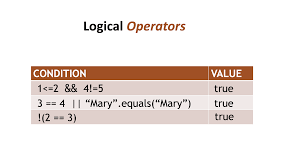
> jogical operators, like a perform in two type of Operators. They are primarily type of Operators.
> Logical AND in java
> Logical OR in java
LOGICAL AND IN JAVA ;
> Logical AND checks whether the two conditions on either side of the expression is true.
> If both the expressions are true then it returns false.
LOGICAL OR IN JAVA ;
> checks whether either of the two conditions in the expression is true. If any one of the expressions is true, it evaluates to true.
> However if none of the conditions are true then it returns false.
> One thing to note is that if the first expression is already true it doesn’t check the second expression and returns true.
UNARY OPERATORS ;
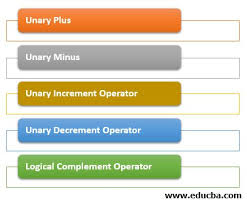
> Unary operators are those which have only one operand. They are of the following types .that’s below ,
> Unary plus Operator
> Unary minus Operator
> Increment Operator
> Decrement Operator
> Logical Not Operator,
UNARY PLUS OPERATORS ;
> A like , Unary plus operator converts byte short and character datatype values into integer values.
> Characters when converted to integers return their ASCII value.
UNARY MINUS OPERATORS OR NEGATIVE OPERATORS ;
> Simpl to Deliberately converts a positive value to a negative value.
INCREMENT OPERATORS ;
> A like as, increment operator is used for increasing the value of a particular value by one.
> However there are a few concepts linked with the increment operator. There are two tyoesy.below ,
PRE- INCREMENT ;
Uni > the value of the variable is first increased and then its used/ or its result is computed. Exp- (++a );
POST- INCREMENT ;
> the value of the variable is first computed and then incremented. Exp- (a++)
DECREMENT OPERATOR ;
> A like , decrement operator is just as opposite to the increment operator. It decreases the value of the variable by 1.
PRE-DECREMENT ;
> the value of the variable is first decreased and then computed. Exp . –a
POST- DECREMENT ;
> the value of the variable is first computed and then decremented by 1. Exp. a–
LOGICAL NOT OPERATOR ;
> Java logical Not operator flips the value of a boolean value. It is denoted by a !.
ASSIGNMENT OPERATORS ;

> Assignment operators are used to assign values to the variables on the left side of the equals sign.
> The associativity is from right to left. Meaning that the values on the right are assigned to the values on the left.
> The right hand side has to be a constant or a defined variable.
TYPE OF ASSIGNMENT ;
> += This returns left=left+right
> -= This returns left=left-right
> *= This returns left=left*right
> /= This returns left=left/right
> %=This returns left=left%right
> As a examples of assignment operator.
RELATIONAL OPERATORS ;
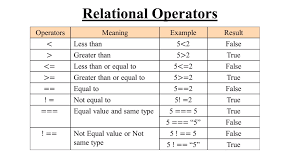
> Relational Operators are used to check the relation between values or variables.
> The output of relational operators is always a boolean value.
> Relational operators are used by if conditions and for loop constraints.
SOME RELATIONAL OPERATORS ;
# < Less than – returns true if left entity lesser than right entity.
# >Greater than – returns true if left entity greater than right entity.
# <=Less than or equal to – returns true if the left entity is smaller than or equal to right.
# >=Greater than or equal to – returns true if left variable is greater than or equal to right entity.
# ==(equals to) – returns true if the left and the right entities are equal.
# !=(not equals to) – returns true if left and right entities are not equal.
BITWISE OPERATOR ;
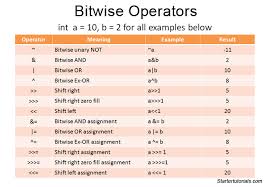
> Bitwise operators are generally used to perform operations on bits of data.
> The individual bits of a number are considered in calculation and not the entire number itself.
TYPE OF BITWISE OPERATOR ;
>AND &
>OR |
>XOR ^
> COMPLEMENT ~
> those are important. There are using a more .after that , operators in minimum usages in our operator.

 SEE JAVA